
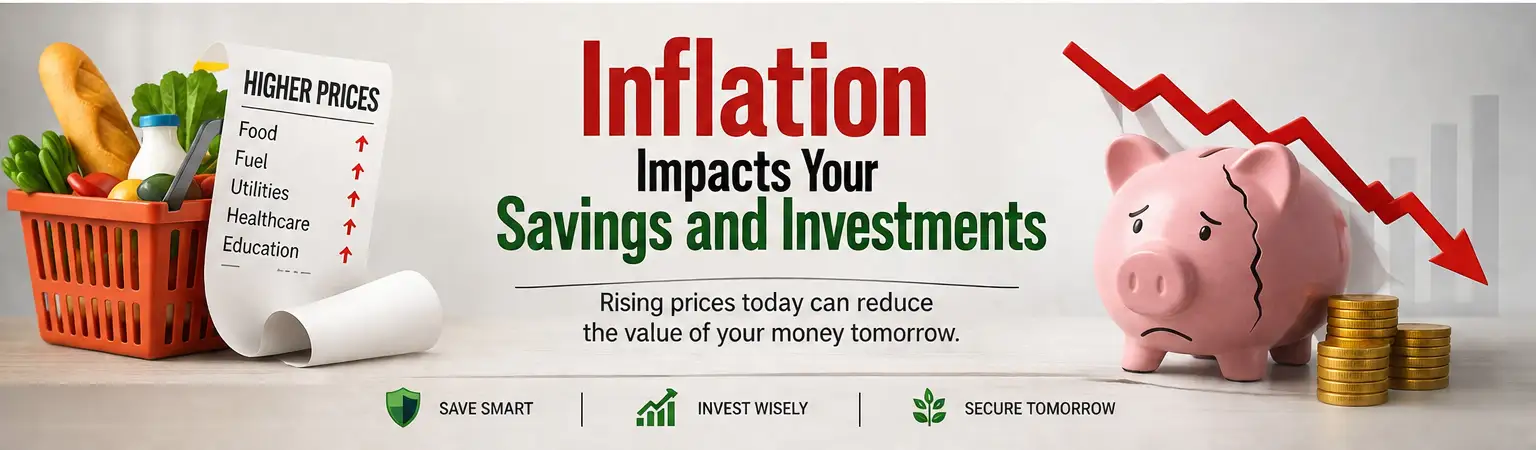
How Inflation Impacts Your Savings and Investments: A Complete Guide
Introduction
Have you ever wondered why the same amount of money buys fewer goods and services over time? A cup of coffee that cost ₹20 a few years ago may cost ₹40 today. Similarly, the price of education, healthcare, housing, and everyday essentials continues to rise.
This increase in the cost of goods and services is called inflation.
Inflation is a natural part of every economy, but if your savings don’t grow at a rate that keeps pace with inflation, your purchasing power gradually declines. That’s why understanding inflation is essential for making informed financial decisions.
In this article, we’ll explain how inflation affects your savings and investments, why it matters, and strategies to help protect your financial future.
What Is Inflation?
Inflation is the rate at which the general prices of goods and services increase over time, reducing the purchasing power of money.
Simply put, the higher the inflation, the less your money can buy in the future.
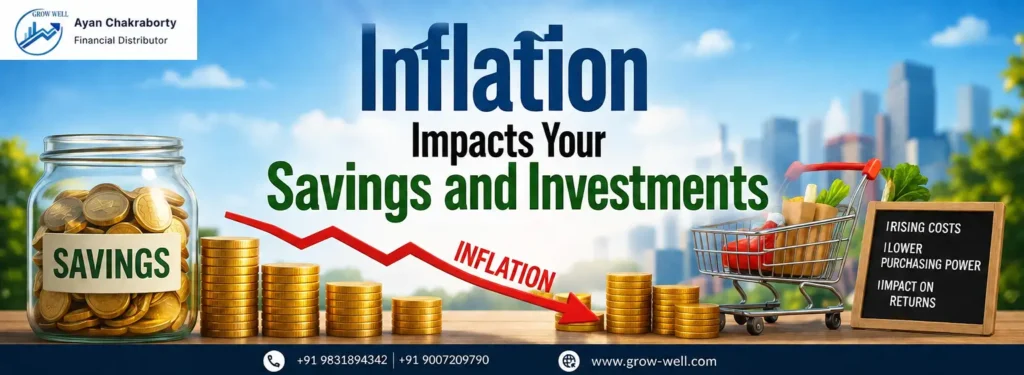
For example:
- Today, ₹1,000 may cover a week's groceries
- After several years of inflation, the same groceries could cost significantly more.
This means your money loses value if it doesn’t grow over time.
Why Does Inflation Occur?
Several factors contribute to inflation, including:
- Increased demand for goods and services
- Higher production and transportation costs
- Rising wages
- Supply chain disruptions
- Government policies
- Global economic events
While moderate inflation is generally considered a normal part of a growing economy, high inflation can significantly affect household finances.
How Inflation Affects Your Savings
Many people keep most of their money in savings accounts because they consider them safe and easily accessible.
While savings accounts provide liquidity, the returns they generate may not always keep pace with inflation.
Example
Suppose you have ₹5,00,000 in a savings account.
If inflation rises faster than the return earned on your savings, the purchasing power of your money may decrease over time.
Even though the balance in your account remains the same or grows slightly, it may buy fewer goods and services in the future.
Inflation and Purchasing Power
Purchasing power refers to the quantity of goods and services your money can buy.
As inflation rises:
- ✓Everyday expenses become more expensive.
- ✓Education costs increase.
- ✓Medical expenses grow.
- ✓Home prices may rise.
- ✓Travel and lifestyle expenses become costlier.
Without planning for inflation, achieving long-term financial goals can become more challenging.
How Inflation Affects Investments
Inflation impacts different types of investments in different ways.
1. Savings Accounts
Savings accounts provide liquidity and security but may not always generate returns that exceed inflation.
2. Fixed Deposits (FDs)
Fixed deposits offer predictable returns, but depending on prevailing interest rates and inflation levels, the real value of those returns may vary.
3. Mutual Funds
Mutual funds invest in different asset classes such as equities, debt, or a combination of both.
Over longer periods, certain categories of mutual funds have historically offered the potential to outpace inflation, although returns are market-linked and not guaranteed.
4. Equity Investments
Companies may increase revenues and profits as the economy grows, which can influence stock prices over time.
However, equity investments are subject to market risks and can experience short-term volatility.
5. Gold
Gold is often viewed by investors as a diversification asset and has historically been used by some as a hedge during periods of economic uncertainty.
Its performance can vary and should be considered as part of a diversified investment strategy rather than a guaranteed protection against inflation.
Why Long-Term Investing Matters
One of the most effective ways to address inflation is to invest with a long-term perspective.
Long-term investing allows your money the opportunity to grow through:
- ✓Compounding
- ✓Capital appreciation
- ✓Regular investments
- ✓Reinvestment of earnings
Although markets fluctuate in the short term, staying invested for longer periods may improve the potential to build wealth.
The Power of SIP During Inflation
A Systematic Investment Plan (SIP) allows investors to invest a fixed amount at regular intervals.
Benefits Include
- ✓Disciplined investing
- ✓Rupee cost averaging
- ✓Potential long-term wealth creation
- ✓Flexibility to start with relatively small amounts
By increasing your SIP over time as your income grows, you may be better positioned to keep pace with rising living costs.
Strategies to Beat Inflation
1. Start Investing Early
The earlier you begin investing, the more time your investments have to potentially grow.
2. Increase Your Investments Regularly
As your salary increases, consider increasing your monthly investment amount.
Many investors choose a Step-Up SIP strategy to gradually raise their contributions.
3. Diversify Your Portfolio
A diversified portfolio may include:
- ✓Equity mutual funds
- ✓Debt mutual funds
- ✓Gold
- ✓Fixed-income investments
Diversification can help manage risk while working toward long-term financial goals.
4. Set Goal-Based Investment Plans
Plan investments for specific objectives such as:
- ✓Retirement
- ✓Child’s education
- ✓Home purchase
- ✓Wealth creation
Considering inflation while estimating future expenses helps determine how much you may need to invest.
5. Review Your Portfolio Periodically
Review your investments at least once a year to ensure they remain aligned with your financial goals and changing circumstances.
Common Mistakes Investors Make
Avoid these common mistakes:
- ✕ Keeping all savings in low-return accounts
- ✕ Ignoring inflation while planning financial goals
- ✕ Delaying investments
- ✕ Investing without diversification
- ✕ Withdrawing long-term investments prematurely
- ✕ Failing to increase investments as income grows
How a Financial Advisor Can Help
A financial advisor can help you:
- ✓ Estimate future costs after accounting for inflation
- ✓ Select suitable investment options
- ✓ Build a diversified portfolio
- ✓ Align investments with your financial goals
- ✓ Review your portfolio periodically
Professional guidance can make financial planning more structured and goal-oriented.
Final Thoughts
Inflation is an unavoidable part of life, but it doesn’t have to prevent you from achieving your financial goals.
Simply saving money may not be enough if your savings fail to keep pace with rising prices. A well-planned investment strategy that considers inflation can help preserve purchasing power and support long-term wealth creation.
By starting early, investing consistently, diversifying your portfolio, and reviewing your financial plan regularly, you can build a stronger foundation for your future.
Remember, the objective isn’t just to save money—it’s to help your money grow so it can support your future needs.
Frequently Asked Questions (FAQs)
What is inflation?
Inflation is the increase in the general prices of goods and services over time, which reduces the purchasing power of money.
How does inflation affect savings?
If the return on your savings is lower than the inflation rate, the real value and purchasing power of your money may decrease over time.
Can mutual funds help beat inflation?
Certain categories of mutual funds have historically provided the potential to outpace inflation over the long term, but returns are market-linked and not guaranteed.
Why is SIP considered a good investment strategy?
SIPs encourage disciplined investing, support rupee cost averaging, and help investors build wealth gradually through regular contributions.
How often should I review my investments?
Reviewing your investment portfolio at least once a year—or after significant life events—is generally recommended to ensure it remains aligned with your goals.